
 To market ourselves effectively to the clients we want to work with, we should
- understand what we can offer them and what makes that offering valuable
- have a clearly defined set of goals and to-do list of steps that will help us reach them.
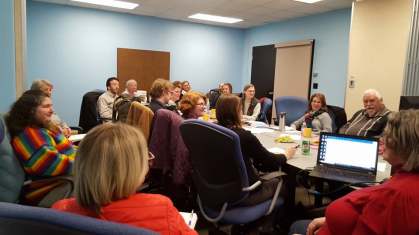
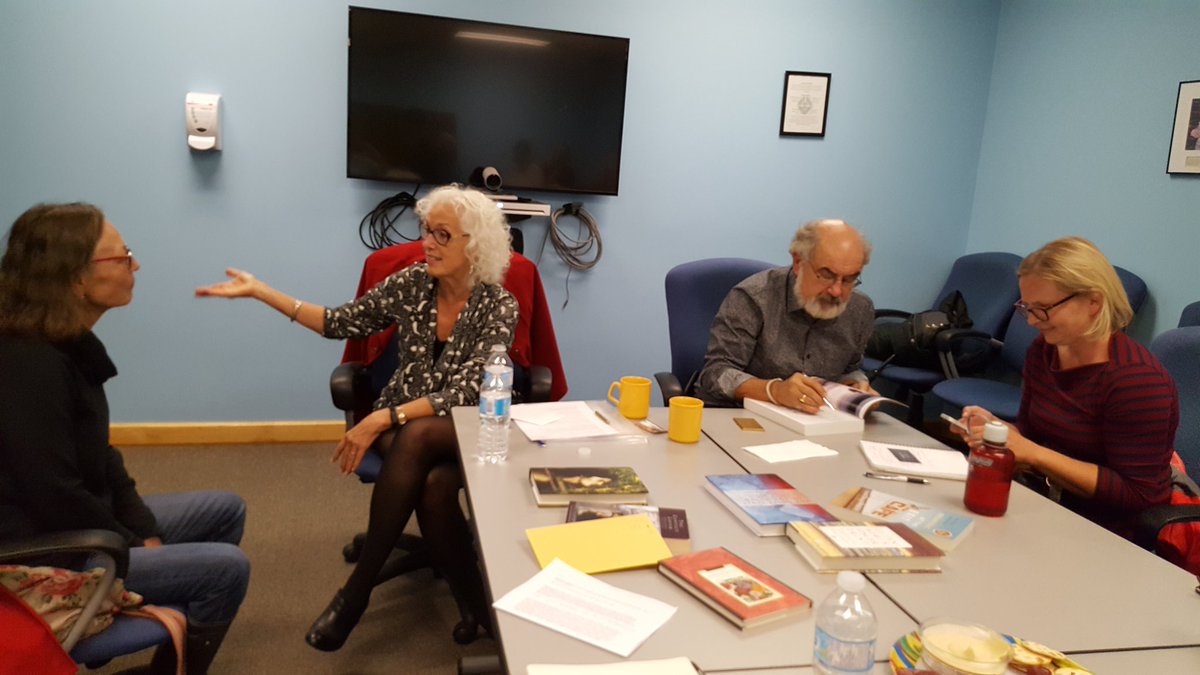
These were key takeaways from our March 14th gathering, a follow-up to January’s marketing-focused evening.
We started the evening sharing overviews of our goals with one another: some of us wanted to develop websites and fluency with social media, while others hoped to attend more publishing-related events or print up-to-date business cards. The most frequently mentioned goal among the freelancers present was to achieve a greater level of income stability. Using Adrienne’s worksheets, we noted such things as who our ideal clients were, what types of editing we could offer them, in what areas of publishing (subject/genre) we desired to work, and what other qualities we had that would differentiate ourselves and our skills from other editors. We compiled notes for cold calling, elevator pitches, and to-do lists.
Who knew competitive marketing could be such a strenuous exercise of looking inward? Some of us might feel overwhelmed just by the idea of marketing ourselves competitively. We’re editors first, after all—our primary focus should be the quality of our editing, right? Nevertheless, good marketing needs to be one of an editor’s priorities.
At night’s end each of us trudged out into the cold from our gathering more confident and ready to do better marketing for our businesses.
Special thanks to Adrienne Montgomerie, who granted us permission to use several worksheets from her upcoming book on marketing a freelance editorial business. (The book is currently available as handouts for Adrienne’s online course through Copyediting.com.)
Announcements
Elizabeth d’Anjou announced that registration was open for the Editors Canada national conference coming up May 25–27 in Saskatoon. The theme is Bridging Communities: Bringing Together Communications-Related Professions. Come party on the prairie with 150 editors! Hear the hilarious James Harbeck, in full tux, host the post-banquet Oops Awards! Stay at the (surprisingly affordable) Radisson Hotel in Saskatchewan’s City of Bridges!
She also mentioned the upcoming webinars, which include
- The Mighty Verb Under the Microscope (May 2)
- Starting a Freelance Editing Career (May 5 & 12)
- Manuscript Evaluation (May 14)
- Demystifying Permissions (June 5, 6, & 7)
Stephanie Stone reminded everyone that the twig’s new fee policy was now in effect: Editors Canada members continue to attend twig meetings free, and visitors are charged $5 per meeting (after the first).
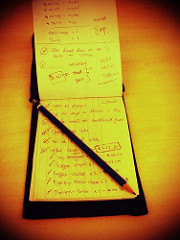
Photo by Justin See (licensed under Creative Commons).

 Elizabeth d’Anjou reminded everyone about the
 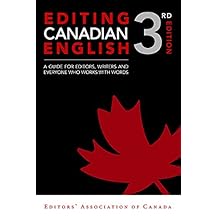 What better way to celebrate Valentine’s Day than by indulging your love of language? Come to the monthly Editors Kingston twig gathering on February 14 for collegial company, networking, snacks—and the inaugural meeting of the Editing Canadian English book club.
 Highlights of Ellie’s list include updating her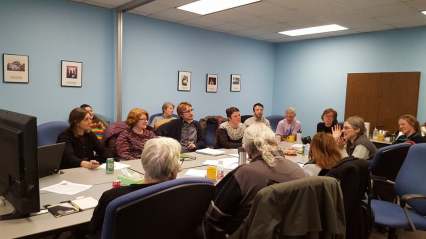
 by Stephanie Stone
 The goal of the workshop was for attendees to learn skills that make online revising faster, more accurate, and efficient—using wildcards, macros, Track Changes, shortcuts, styles, and more. By applying our new-found skills, we would be able to reduce the mechanics and tedium of revising and editing so that we could focus on developing our ideas and honing our arguments.
 A week before the seminar, Adrienne asked us to send her a list of topics we wanted to cover, and she amalgamated them into an overall list for the day. We also referred to her recently published and indispensable book,
  Rick also graciously answered many questions about his writing from a professional point of view, especially as it related to the editing process.



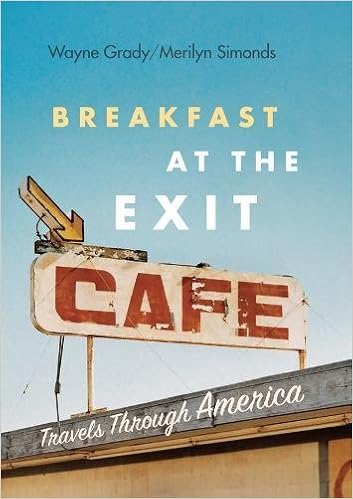 Writers, she said, are so involved in the process of creating that they often don’t have room in their mind to be keenly aware of correctness, clarity, and consistency. Merilyn’s message served to remind that a writer has a starkly different job than an editor’s—writers are responsible for creation; editors, for editing. Merilyn said, “The best editors don’t have opinions but rather help a writer with her vision.” She added that every writer has different needs—that a good editor can still be the wrong one. (Indeed, she told one tale of trying to work with an editor who was so very wrong for the project at hand that many in the audience gasped audibly at some of the details.)
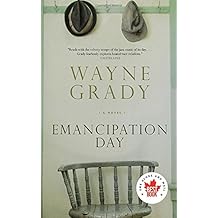 Wayne began his portion of the night by recounting his experience working with editors on his acclaimed debut novel, Emancipation Day, published in 2013 by Doubleday Canada. His inspiration for the novel arrived after learning the startling truth about his family: his father was black, and perhaps didn’t want his family to know. Having decided to fictionalize the story, Wayne, who until then had been a non-fiction writer, found himself unable to know where to draw the line. The novel’s first draft almost reached a thousand pages and encompassed a story told over a century. It even featured a cameo of “Victor Hugo in Vietnam.” Wayne knew he needed help to focus it. He finally found that help when Nita Pronovost read the manuscript and promptly ticked off three specific areas that needed his attention in order for it to work.
 editorskingston.org