
February Meeting Report: Academic Acquisitions Editing

2016-02-10 20.44.42

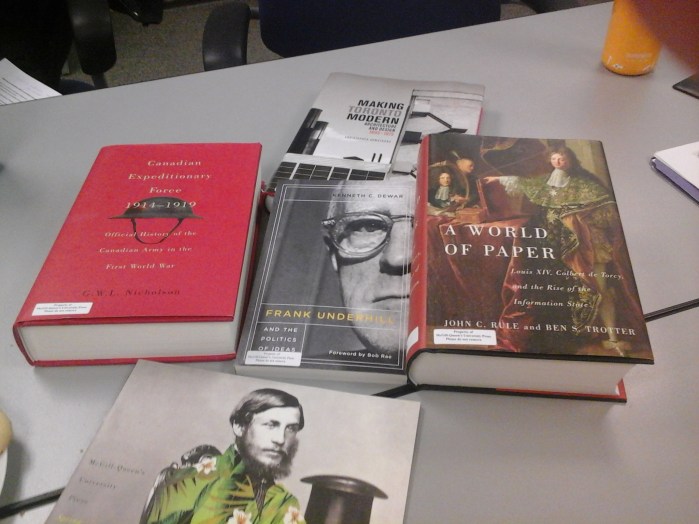
Guest speaker James McNevin, acquisitions editor for McGill-Queens University Press, brought some of the press’s current titles for show and tell.


Association News

Nearby Editors Canada seminars coming up include “Copyediting II” on March 22 in Ottawa and both “Manuscript Evaluation” and “Creating a House Style” (the latter presented by our own Elizabeth d’Anjou), also on March 22, in Toronto.

The conference is coming! The national Editors Canada conference this year will be held June 10, 11, and 12 at the Coast Plaza Hotel & Suites in Vancouver, B.C. The theme is “A Correction Connection.” Keynote speakers will be

  • Mary Norris — copyeditor for The New Yorker, presenter of delightful YouTube grammar videos, and author of the bestseller Between  You and Me (Ellie shared around her copy)
  • Bill Walsh — copyeditor at The Washington Post, blogger at The Slot, and host of a popular monthly online “Grammar Geekery” chat

Speaker: James McNevin

James McNevin, acquisitions editor for McGill-Queens University Press, spoke to a full room of interested Editors Kingston members and visitors at the February 10 meeting.

The topic drew several new faces, including graduate students and professors from Queen’s University and the Royal Military College of Canada.

Acquisitions Editing — A Day in the Life
2016-02-10 20.11.15

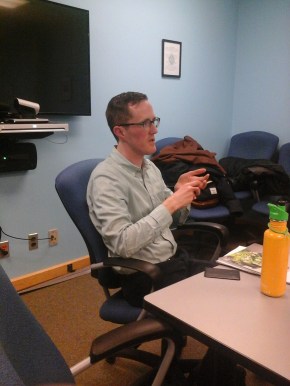
James McNevin

At our request, James focused his remarks on exploring the question “What does an acquisitions editor at a university press do?” The answer turns out to include the following:


  • scouts for new authors — These are found by attending conferences, keeping abreast of journal articles in his disciplines, scanning bibliographies, checking university departmental websites, and looking to see what other university presses are up to.
  • brings in new manuscripts — The target at McGill-Queens is an optimistic 20 to 25 manuscripts a year.
  • evaluates proposals — Academics have to write book proposals, just like authors of trade nonfiction. (Attendee Angela Pietrobon pointed out that this fact provides an opportunity for freelancers: she helps authors write proposals for the University of Toronto Press.)
  • finds peer reviewers — Peer review is what distinguishes university presses from all other types of publishing. James stressed the importance of finding good reviewers: fair, qualified, and open to the author’s point of view (with no axe to grind) but willing and able to respond to it critically.
  • solicits a response to the peer review — An ideal author’s response is thoughtful and not defensive, and shows a willingness to revise. (Angela commented that she also helps authors with this stage.)
  • finds funding for each title — Acquisitions editors at a university press spend a lot of time on this task, James explained. Since the market for academic books is so small, the press can’t count very much on sales revenues. The money to publish a title can come from a wide range of sources: government grants, special funds focused on particular subjects, sometimes even the author’s own university department.
  • gets manuscripts ready for transmittal to editorial  — The managing editor then oversees the copyedit and proofreading (at McGill-Queen’s, the same freelancer usually performs both of these tasks for a given title).
  • draws up the contract— The stakes here are not particularly high in academic publishing, James said, but as some university presses are moving into nonfiction trade books with the potential for much larger audiences, there are exceptions.
    2016-02-10 20.10.37

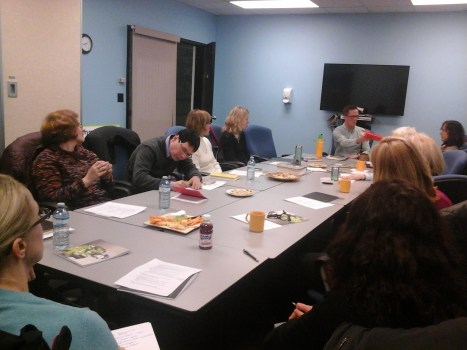
    Books, snacks, drinks: A group of happy editors!

  • checks images and permissions— The author is responsible for providing usable versions of any images to be included and for seeking any necessary permission to reproduce copyrighted material, but may need help understanding what is required and carrying it out.
  •  liaises with the marketing department — The acquisitions editor is in the best position to provide marketing with info about the book and why it’s important.

The presentation was followed by lots of questions and discussion over cookies and coffee. And, of course, by much admiration of the books James had brought for show and tell!

Write-up by Ellie Barton with Elizabeth d’Anjou. Photos by Elizabeth d’Anjou.



Coming Up February 10: Acquisitions Editing

McGill-Queens UPAre you curious about what goes on behind the scenes at a university press?
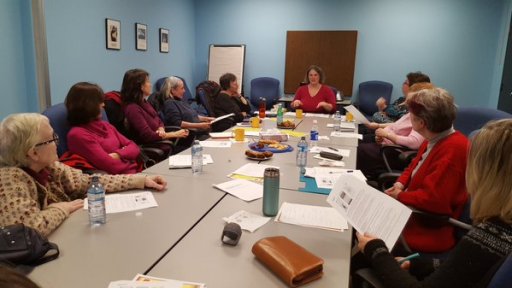

On Wednesday, February 10, acquisitions editor James MacNevin of McGill-Queen’s University Press will take us through the acquisitions and editorial process. With examples and anecdotes from his own experience, he will explain

  • how a press builds a list in a given subject area, including finding suitable manuscripts and recruiting authors
  • how manuscripts are evaluated and developed, including the various roles of acquisitions editor, managing editor, and freelance editors
  • where the marketing department comes in
  • what it takes to be an effective acquisitions editor.

Those of us who work on academic press books as freelancers enter the picture long after the major decisions have been made. With this talk, our guest speaker will provide a view from the other side of the desk. We’ll come away with a better understanding of where copy editors (and stylistic editors) fit in the process, what has gone on before, and what happens to the manuscript after our work is done.

There will be ample time for questions and discussion.

About the Speaker

James MacNevin specializes in history, geography, sociology, and cultural studies. Prior to joining McGill-Queen’s University Press in 2013, he held a similar position with a textbook publisher, and prior to that he worked in trade publishing. In addition to his career in book publishing, he is a freelance writer and historian.

Come Join Us!

Wednesday, February 10

7 to 9 p.m. (doors open at 6:30)

Ongwanada Resource Centre, 191 Portsmouth Avenue (map)

Free

Bring a friend!

January Meeting Report: Estimating

Photo Estimating Talk

“An editing job is worth what someone will pay for it.” Elizabeth d’Anjou talks about estimating at the Editors Kingston meeting on January 13.

Association News

At the Editors Kingston January 13 meeting, coordinator Ellie Barton began by sharing some association news:

  • Winter/spring series of editing-related seminars have been announced by both the Editors Toronto and Editors Ottawa-Gatineau groups. (And tonight’s speaker, our own Elizabeth d’Anjou, is teaching two of the Editors Toronto offerings.)
  • The Professional Editorial Standards are being reviewed this year. The task force working on the project welcomes input from members, and will also be eventually seeking some non-member reviewers. The standards are an Editors Canada publication that lay out what a professional editor does (or should do); they are the basis of the Editors Canada certification exams. Watch for info from the Editors Canada office or contact chairs Moira White <moira@ubiquitext.ca> and Michelle Boulton <michelle@3cpublications.ca>.

Speaker

Thanks to Hélène Lawler for the following report.

We were treated to the wisdom of seasoned freelance editor Elizabeth d’Anjou on that ever-elusive topic we’re all keen to know more about: money. Or, more precisely, how to earn more of it!

Possibly the only aspect of freelancing more challenging than landing new gigs is figuring out how much to charge for them. Part art, part science, coming up with accurate estimates can make the difference between earning a healthy income and struggling to make ends meet.

Through years of experience and more trial and error than she’d care to remember, Elizabeth has developed some strategies for addressing this challenge, which she generously shared with the group during her talk.

Elizabeth admitted that, early in her career, she had thought she could easily estimate how long a project would take by simply dividing the number of pages in a project by an average editing pace in pages per hour. She learned the hard way, however, that there is usually more to it than that. Today she starts with a formula something like this:

(# of pages / pages per hour) + special items + negotiating alts (30–50%) + other tasks + admin time

Elizabeth then went into detail about each component, offering useful tips along the way. For example, we were warned to always request the word count—not the page count—and to ask important questions such as “who else is involved in the process of approval?” and “what is the process for negotiating changes?”

There’s so much to keep in mind! So many different pieces that may crop up and add in time, effectively reducing our hourly rate if we haven’t factored them in to our initial estimate. For this reason, Elizabeth pointed out, getting the same kind of work repeatedly can make a big difference in accurate estimating.

Next we delved into setting rates. There is no one “typical” rate for editing; pay scales differ dramatically across industries and disciplines, and can also vary according to the type of editing. As a very rough guide, Elizabeth said, common hourly charges range from $25 to $65 or more per hour.

When deciding what to charge per hour, Elizabeth reminded us that we freelancers must factor in all the non-billable hours we log, as well as any overhead. A simple rule of thumb is that our hourly rate x 1,000 roughly equals our yearly salary, based on approximately 25 billable hours of work per week.

Elizabeth encouraged us not to undervalue editing services, and pointed out that, ultimately, an editing job is worth whatever someone is willing to pay for it.

Estimating and Setting Rates

abacus_34437

The Editors Kingston meeting on Wednesday, January 13, will feature a presentation by Elizabeth d’Anjou on freelance editing estimating and rates. Come join us!

Estimating and setting fees are among the biggest challenges faced by self-employed editors. (Publishers and others who hire editors face the same issues from the other direction.) While there is no magic solution, Elizabeth d’Anjou offers practical, specific advice on these topics from her own experience and that of seasoned colleagues, including recommendations for useful tools and resources.

OLYMPUS DIGITAL CAMERAElizabeth is the assistant coordinator of Editors Kingston and a freelance editor with over 20 years’ experience. She has presented the popular Editors Canada seminar Taking the Plunge: Starting Out as a Freelance Editor across the country. Her clientèle includes educational publishers, nonprofit organizations, government agencies, and academics. She also teaches grammar and copy editing online in Ryerson University`s Publishing Certificate Program.

Details

Wednesday, January 13, 7 p.m. to 9 p.m. (come any time from 6:30)

Ongwanada Resource Centre, 191 Portsmouth Ave, Kingston, ON (map)


*Abacus Image: “Calculator” By Anssi Koskinen from Turku, Finland [CC BY 2.0 (http://creativecommons.org/licenses/by/2.0)%5D, via Wikimedia Commons